How to Check Tire Tread Depth (Penny Test and Better Methods)
Learn how to check tire tread depth with the penny test, quarter test, wear bars and a gauge, plus when to replace tires at 4/32 inch.
Your tires are legally worn out at 2/32 inch of tread, but most safety groups, including AAA, suggest replacing them sooner—around 4/32 inch—because wet-road grip falls off well before you hit the legal limit. You can check tread in under two minutes with a penny, a quarter, or a cheap gauge. Here’s exactly how, and how to read what you find.
Why tread depth matters
Tread grooves have one main job: moving water and slush out from under the tire so the rubber can touch the road. As the grooves wear down, they move less water, and your stopping distance on a wet road gets longer.
The drop-off is not gradual at the end—it accelerates. Tires at 4/32 inch already stop noticeably longer in the rain than new tires, and at 2/32 inch the difference is dramatic. In standing water, worn tires are far more likely to hydroplane, where the tire rides up on a film of water and you briefly lose steering and braking.
Snow needs even more tread. Packed snow grabs best when there’s deep tread for it to bite into, which is why winter driving is harder on marginal tires. If you deal with real winters, see how to get your car ready for winter.
Tread also matters for safety systems. Anti-lock brakes and stability control can only work with whatever grip the tire provides. Bald tires limit what any amount of electronics can do.
What the numbers mean
Tread depth is measured in thirty-seconds of an inch (32nds). New passenger-car tires usually start around 10/32 to 11/32 inch. Some all-terrain and truck tires start deeper.
| Tread depth | What it means | Action |
|---|---|---|
| 8/32”–11/32” | New or nearly new | Normal driving |
| 5/32”–7/32” | Worn but serviceable | Keep monitoring |
| 4/32” | Wet-weather grip fading | Start shopping, replace soon |
| 3/32” | Marginal, poor in rain/snow | Replace |
| 2/32” | US legal minimum | Replace now—unsafe |
| Below 2/32” | Illegal and dangerous | Do not drive on it |
In the US, the legal minimum in most states is 2/32 inch. In the UK, the legal minimum is 1.6 mm (about the same, measured across the central three-quarters of the tread). Canada and Australia generally follow the 1.6 mm figure as well. Legal minimum is the point at which a tire is no longer road-legal—not the point where it’s still “fine.”
The penny test (quick and free)
The penny test checks whether you’re at or below the 2/32-inch legal limit. It uses Lincoln’s head on a US one-cent coin.
- Take a penny and hold it with Lincoln’s head pointing down.
- Insert it into a tread groove so his head goes into the gap.
- Look at the top of his head.
- If part of Lincoln’s head is covered by the tread, you have more than 2/32 inch left.
- If you can see the top of his head and the space above it, you’re at or below 2/32 inch. The tire is worn out—replace it.
Check in several spots across the tire and around its circumference, because tires rarely wear evenly. Pay attention to the groove that looks shallowest.
The penny test has one weakness: it only tells you when you’ve already hit the legal limit, which is too late for good wet-weather safety.
The quarter test (a smarter early warning)
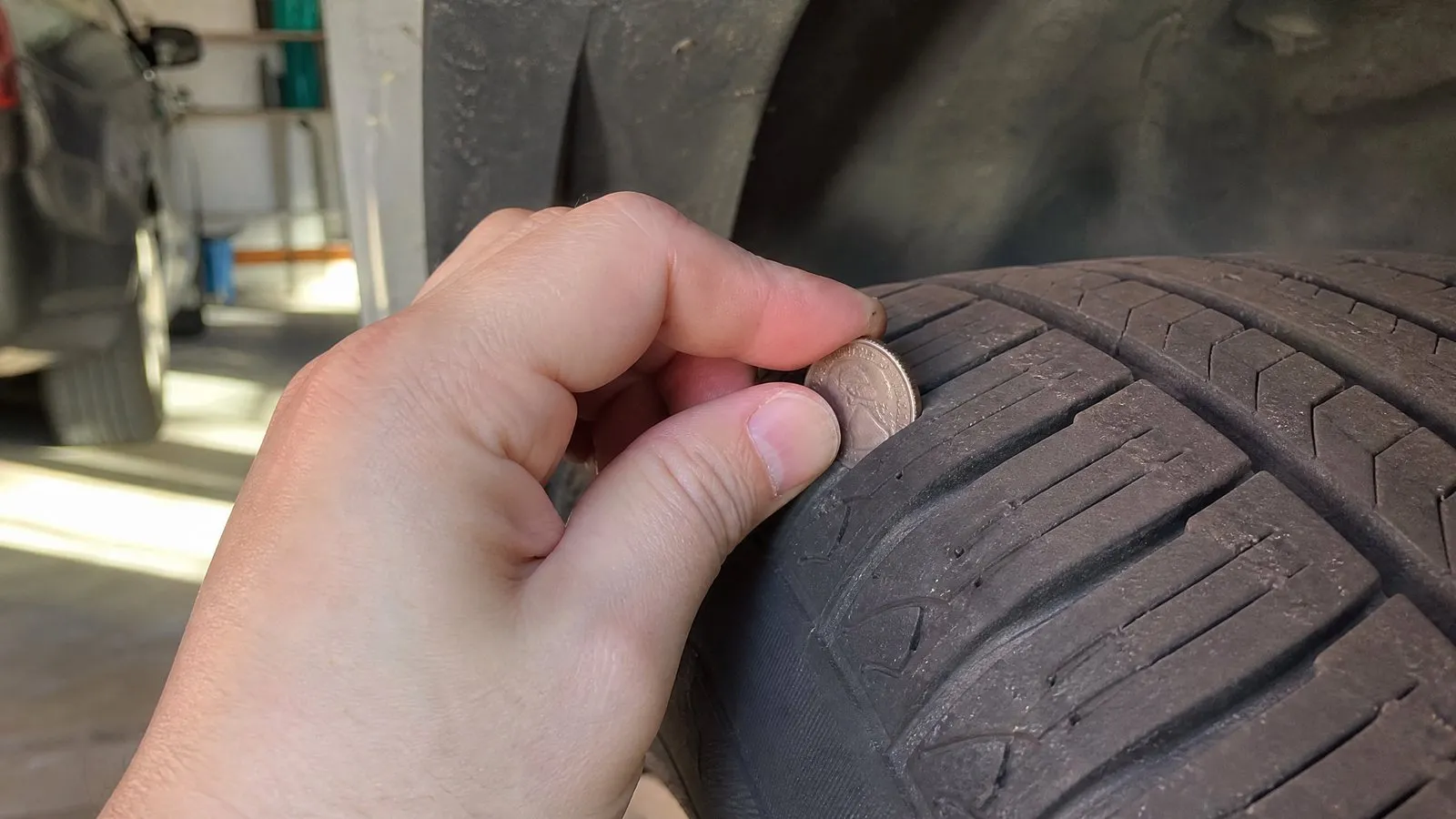
The quarter test uses the same idea but a more useful threshold. On a US quarter, the distance from the edge to the top of Washington’s head is roughly 4/32 inch—the point where safety groups suggest replacement for wet roads.
- Hold a quarter with Washington’s head pointing down.
- Insert it into a tread groove.
- If the tread reaches Washington’s head, you still have more than 4/32 inch.
- If the top of his head is fully visible, you’re at or below 4/32 inch—time to start shopping for tires, especially before a wet or snowy season.
Think of it this way: penny = “replace now,” quarter = “plan to replace.”
Tread wear indicator bars
Every modern tire has built-in wear bars—small raised ridges of rubber that sit across the bottom of the grooves. They’re molded in at 2/32 inch, so when the surrounding tread wears down level with the bars, the tire is at the legal limit.
To find them:
- Look for small triangle marks (▲) or the letters TWI on the tire’s shoulder. They point to where the bars sit.
- Look down into the grooves at those spots.
If the tread surface is flush with a wear bar, the tire is done. If the bars are clearly below the tread, you still have some life left. Wear bars are convenient but blunt—like the penny, they only flag the legal minimum, not the safer 4/32-inch point.
Using a tread depth gauge (the most accurate)
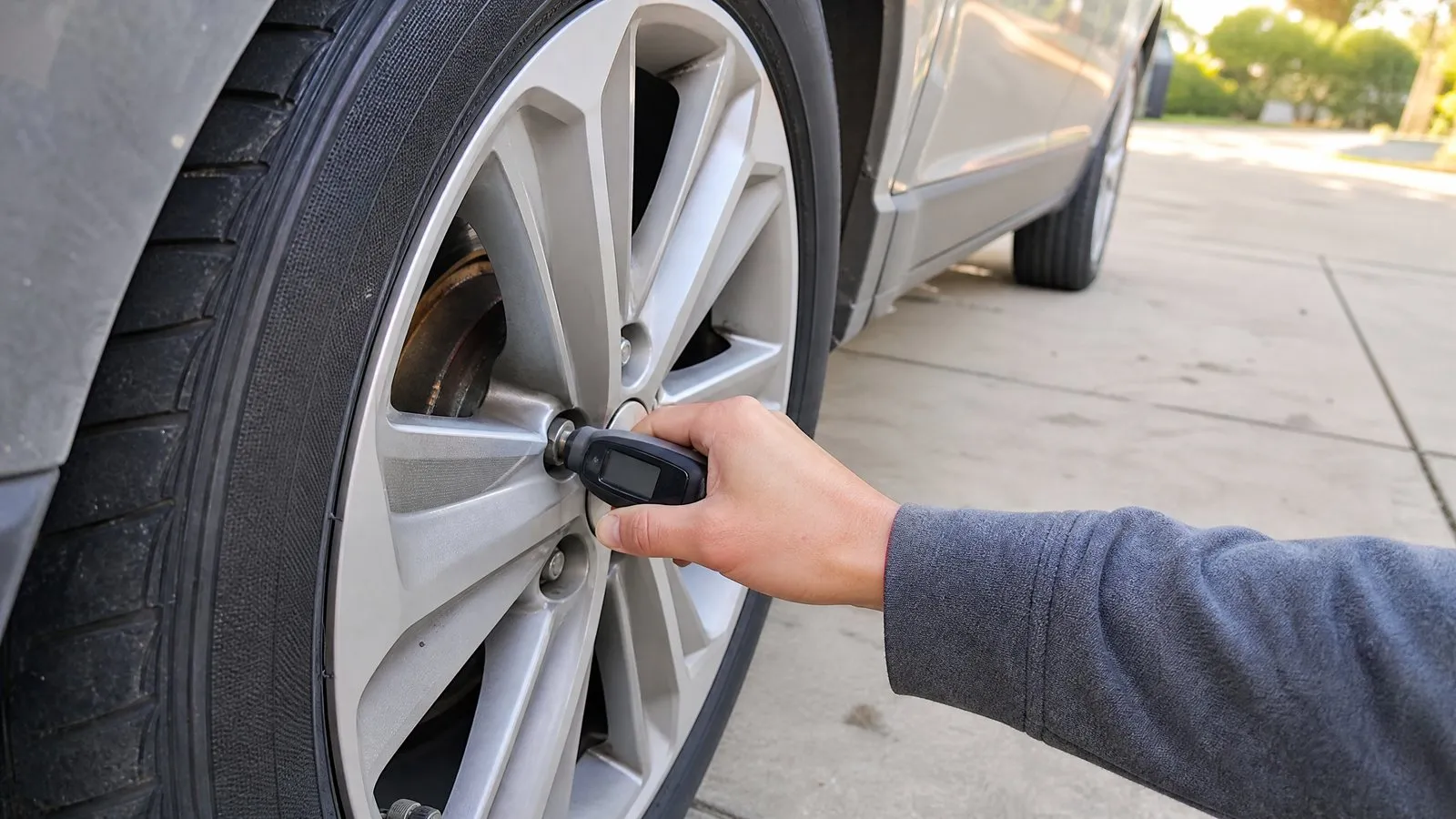
A dedicated tread depth gauge costs only a few dollars and gives you an actual number instead of a pass/fail. This is the method we’d recommend if you want to track wear over time or compare tires.
There are two common types:
- Probe (pin) gauges: a sliding pin you press into the groove; it reads in 32nds, and often millimeters too.
- Digital gauges: same idea with a digital display.
How to use one:
- Press the base flat against the tread blocks, spanning the groove.
- Push the probe down to the bottom of the groove.
- Read the number where the scale shows.
- Repeat in the inner, center, and outer grooves, and at three points around the tire.
Write down the lowest reading—that’s the one that governs safety. A tire that reads 7/32 inch in the center but 3/32 inch on one edge is telling you something important, which brings us to wear patterns.
Reading uneven wear patterns
When tread wears unevenly, the tire is pointing at another problem. Checking tread depth in multiple spots lets you catch these early.
Both outer edges worn, center fine
Classic sign of chronic underinflation. The tire’s edges carry too much load when it’s low on air. Fix your pressures and check them monthly—see how to check tire pressure the right way. If a warning light is involved, read about the tire pressure light (TPMS).
Center worn, edges fine
Usually overinflation—too much air bulges the center of the tread into the road.
One edge worn (inner or outer)
Often an alignment problem (camber or toe out of spec). This needs a shop; a wheel alignment typically runs about $80 to $150. Left alone, it ruins tires fast.
Patchy, scalloped, or cupped wear
Suggests worn suspension parts (shocks, struts, bushings) or wheels that are out of balance. Have the suspension inspected.
Flat spots
A single flat patch can come from a hard braking lockup or from a car sitting in one position for a long time.
Regular tire rotation evens out the normal difference between front and rear wear and makes your tires last longer. If one tire is wearing far faster than the others even after rotation, get the alignment and suspension checked.
How often to check
Make tread a part of your routine rather than a one-time thing:
- Monthly, alongside tire pressure. It takes seconds once you’re already crouched by the wheel. Fold it into the 10-minute monthly car checklist.
- Before any long road trip. See what to check before a long road trip.
- Before winter, if you drive in snow.
- Any time you notice longer wet stopping distances, more road noise, or vibration.
Checking at the same time as other quick jobs—oil, washer fluid, wipers—keeps it from being forgotten. Our car maintenance schedule for beginners lays out the full rhythm.
When to replace, and what else to know
Replace a tire when:
- Any groove reaches 2/32 inch (legal minimum)—non-negotiable.
- Tread is around 4/32 inch and you regularly drive in rain or snow—strongly recommended.
- You see cords, bulges, cracks in the sidewall, or a repair that can’t be made safely.
A couple of points that often surprise people:
Age matters, not just tread. Rubber hardens and cracks over time. Many manufacturers suggest considering replacement at 6 years and replacing by 10 years regardless of tread, because old rubber loses grip and can fail. Check the DOT date code on the sidewall—the last four digits are the week and year of manufacture (for example, “2219” means the 22nd week of 2019).
Replace in pairs or sets when you can. Mismatched tread depths, especially front-to-rear, can upset handling. On all-wheel-drive vehicles, the manufacturer often requires closely matched tread on all four tires to avoid drivetrain damage—check your owner’s manual.
Your owner’s manual is the final word on tire size, pressure, and replacement guidance for your specific car.
If you also notice longer stopping distances or noise from the brakes rather than the tires, that’s a separate issue—see the signs your brakes need attention.
FAQ
Is the penny test actually reliable?
It’s reliable for one thing: telling you when a tire has hit the 2/32-inch legal limit. It’s a solid free check. Its limitation is that it only flags the point where the tire is already unsafe. For earlier warning, use the quarter test (about 4/32 inch) or a tread depth gauge for an exact number.
What is the minimum legal tread depth?
In the US, it’s 2/32 inch in most states. In the UK, Canada, and Australia, the standard is 1.6 mm, which is roughly the same. These are legal minimums, not safety recommendations—AAA and others suggest replacing around 4/32 inch for wet-road performance.
How long do tires usually last?
Most passenger tires last 40,000 to 60,000 miles, though it ranges widely with driving style, alignment, inflation, and rotation habits. Rubber also ages: plan to replace tires by about 10 years old regardless of mileage. Keeping tires properly inflated and rotated is the cheapest way to get full life out of them.
Can I replace just one tire?
Sometimes, but it’s not ideal. A single new tire paired with worn ones can make the car handle unevenly. Replacing in pairs (both front or both rear) is better, and all-wheel-drive vehicles often require all four matched—check your manual. If you do replace one or two, the newer tires generally go on the rear for more stable handling in the wet.
Does low tread affect anything besides grip?
Yes. Worn tires are more prone to hydroplaning, take longer to stop, and give your anti-lock brakes and stability control less to work with. Uneven tread wear can also signal alignment or suspension problems that will keep destroying tires until they’re fixed.
A note on health information: Our guides are general information for typical passenger cars. Always follow your vehicle's owner's manual, and have safety-critical problems such as brakes or steering checked by a qualified mechanic. If a warning light is red or the car drives differently, stop safely and get help.